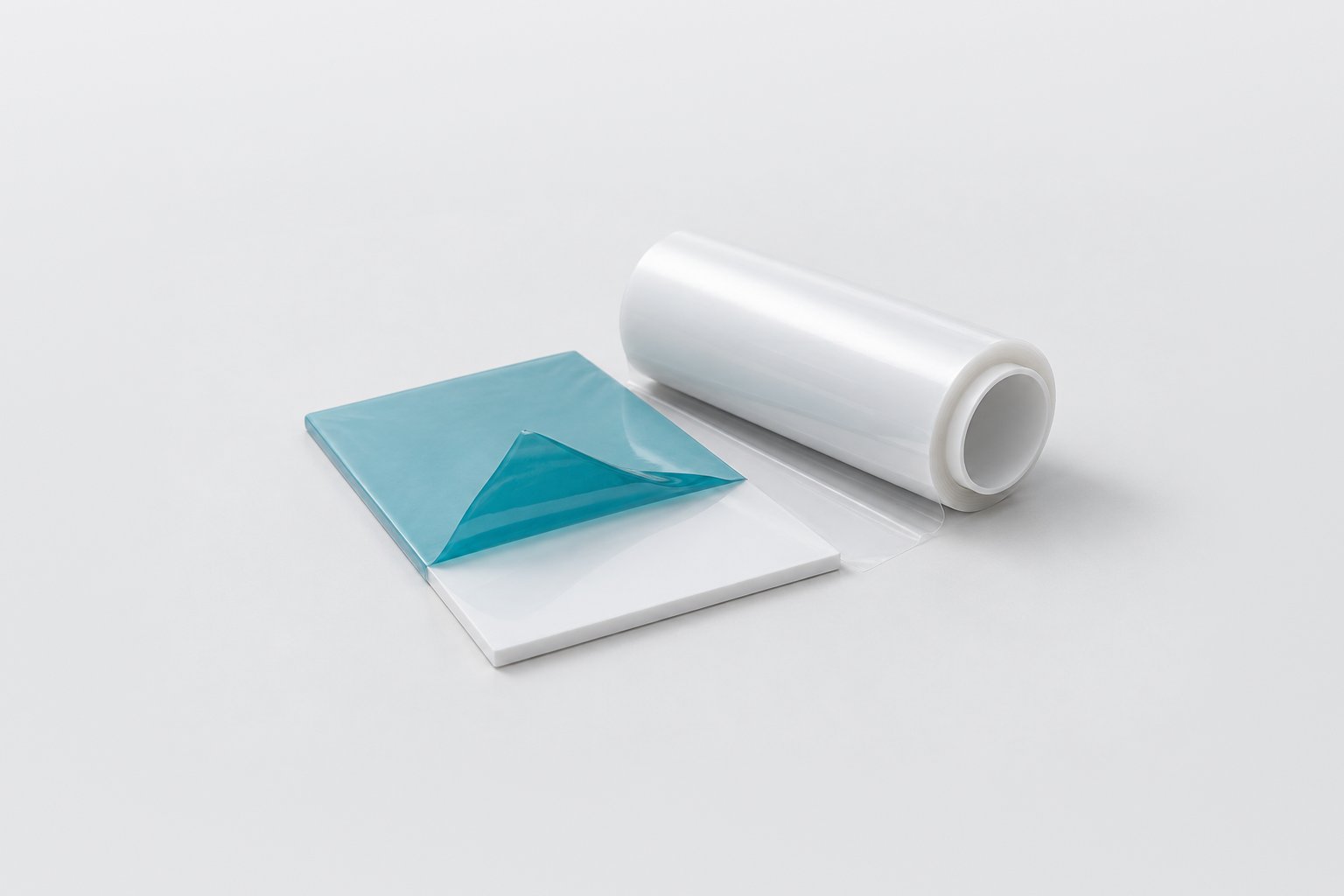
— APPLICATION
Polypropylene and LDPE film for food packaging and lamination
Polypropylene food packaging film and LDPE sealant film are rarely used on their own. Most food packs are laminates, and each film does one job in the structure: it seals, carries the print, adds stiffness or survives the retort. The job decides the polymer and the line, blown or cast. This page explains how, and shows the grades we can supply for food and lamination film.

— REQUIREMENTS
What a film layer does in the pack
The sealant layer has to seal at a low temperature and hold while the seal is still hot. On a vertical form-fill-seal line the product drops onto a seal made a fraction of a second earlier, so hot tack decides the line speed. The outer layer carries print and gloss. A snack or bakery pack that looks hazy on the shelf looks old.
In a laminate the layers also have to stay together. Weak adhesion between the sealant film and the printed web shows up as delamination after filling, in the freezer or after a retort cycle.
— SELECTION
Choosing a cast PP film grade or an LDPE lamination film grade
Start with the line. LDPE runs on blown film lines, where its long-chain branching gives the melt strength for a stable bubble. Polypropylene food film is mostly cast and quenched on a chill roll, which gives clarity.
PP random copolymer is the usual cast sealant. It seals at a lower temperature than homopolymer and makes clear, glossy film.
PP homopolymer cast film is stiffer and very clear, for bakery, confectionery and twist packs and for outer lamination webs.
PP impact copolymer gives tough film with high seal strength, which is why it is used in laminates that go through a retort.
LDPE is the classic sealant for laminates with PET, BOPP film or foil. HDPE film adds stiffness at low thickness.
Then look at additives. Slip and antiblock help film run on a packing line, but slip migrates to the surface and can weaken the lamination bond and print adhesion. For film that will be laminated, start from a grade without slip.
— GRADES
Grades we can supply
Check each data sheet for slip and antiblock content before you plan a laminate.
PP homopolymer
KeyForm
·
Velogy
PP
KeyForm P1003
PP homopolymer
KeyForm P1003 is a high-flow polypropylene homopolymer for biaxially oriented polypropylene (BOPP) film on tubular double-bubble lines and for cast film.
Film extrusion
BOPP
Industries

Flexible packaging
KeyForm
·
Velogy
PP
KeyForm P1002
PP homopolymer
KeyForm P1002 is a polypropylene homopolymer without slip or antiblocking additives, for cast film. Typical uses include packaging and lamination films for food, flowers, books, stationery and textiles.
Film extrusion
Industries
Flexible packaging
KeyForm
·
Velogy
PP
KeyForm P1050
PP homopolymer
KeyForm P1050 is a polypropylene homopolymer containing slip and antiblocking additives, for cast film. Typical applications include packaging and lamination films for food, flowers, books and stationery.
Film extrusion
Industries
Flexible packaging
PP random copolymer
AdvyForm
·
Velogy
PP
AdvyForm R1001
PP random copolymer
AdvyForm R1001 is a controlled-rheology, medium-modified propylene random copolymer for transparent cast film. It contains no slip or antiblocking agents.
Film extrusion
Industries
Flexible packaging
AdvyForm
·
Velogy
PP
AdvyForm R1050
PP random copolymer
AdvyForm R1050 is a controlled-rheology, medium-modified propylene random copolymer for transparent cast film. It contains slip and antiblocking additives.
Film extrusion
Industries
Flexible packaging
AdvyForm
·
Velogy
PP
AdvyForm R1051
PP random copolymer
AdvyForm R1051 is a controlled-rheology, medium-modified polypropylene random copolymer for cast film. It contains slip and antiblocking additives.
Film extrusion
Industries
Flexible packaging
LDPE
KeyForm
·
Velogy
LDPE
KeyForm L0401
LDPE
KeyForm L0401 is a non-additivated low-density polyethylene, for blown-film extrusion. Its high melt strength supports bubble stability.
Film extrusion
Blown film extrusion
Extrusion blow moulding
Industries
Flexible packaging

Rigid packaging
KeyForm
·
Velogy
LDPE
KeyForm L0600
LDPE
KeyForm L0600 is a non-additivated low-density polyethylene, supplied as pellets. Its good melt strength supports bubble stability during blown-film extrusion.
Film extrusion
Blown film extrusion
Industries
Flexible packaging
KeyForm
·
Velogy
LDPE
KeyForm L0850
LDPE
KeyForm L0850 is a low-density polyethylene containing slip and antiblocking additives. It offers a balance of processability and mechanical properties.
Film extrusion
Blown film extrusion
Industries
Flexible packaging
— NEED HELP CHOOSING?
Not sure which grade fits?
Send us the laminate structure, the layer you need, your line type and the filling conditions.
— PROCESSING
Blown or cast
Blown film is tougher and more balanced in both directions. Cast film gives better clarity, gloss and gauge control, and runs faster. Many cast PP grades are controlled-rheology types with a narrow molecular weight distribution, which helps the melt draw down thin and evenly. Melt flow rate is measured at 190 °C for LDPE and at 230 °C for PP, so compare like with like. Tell us the line, die gap and target thickness.
Blown film extrusion
Film extrusion
— DOCUMENTATION
Food contact rules for laminates
Under Regulation (EU) No 10/2011 every plastic layer in a laminate must comply, and the finished laminate must meet the migration limits. Since Regulation (EU) 2025/351 this also applies to laminates with foil or paper when the layer touching the food is plastic. A declaration of compliance is needed at each stage before retail: the producer issues one for the grade, which we pass on, and the converter issues one for the film.
— PRODUCERS
Producers for this application

Brands for this application
— FAQ
Common questions
Should an LDPE blown film grade for lamination contain slip?
Which film survives retort sterilisation?
Can I get food-contact documents before trials?
— RELATED