— APPLICATION
Film grades for surface protection, release and hygiene film
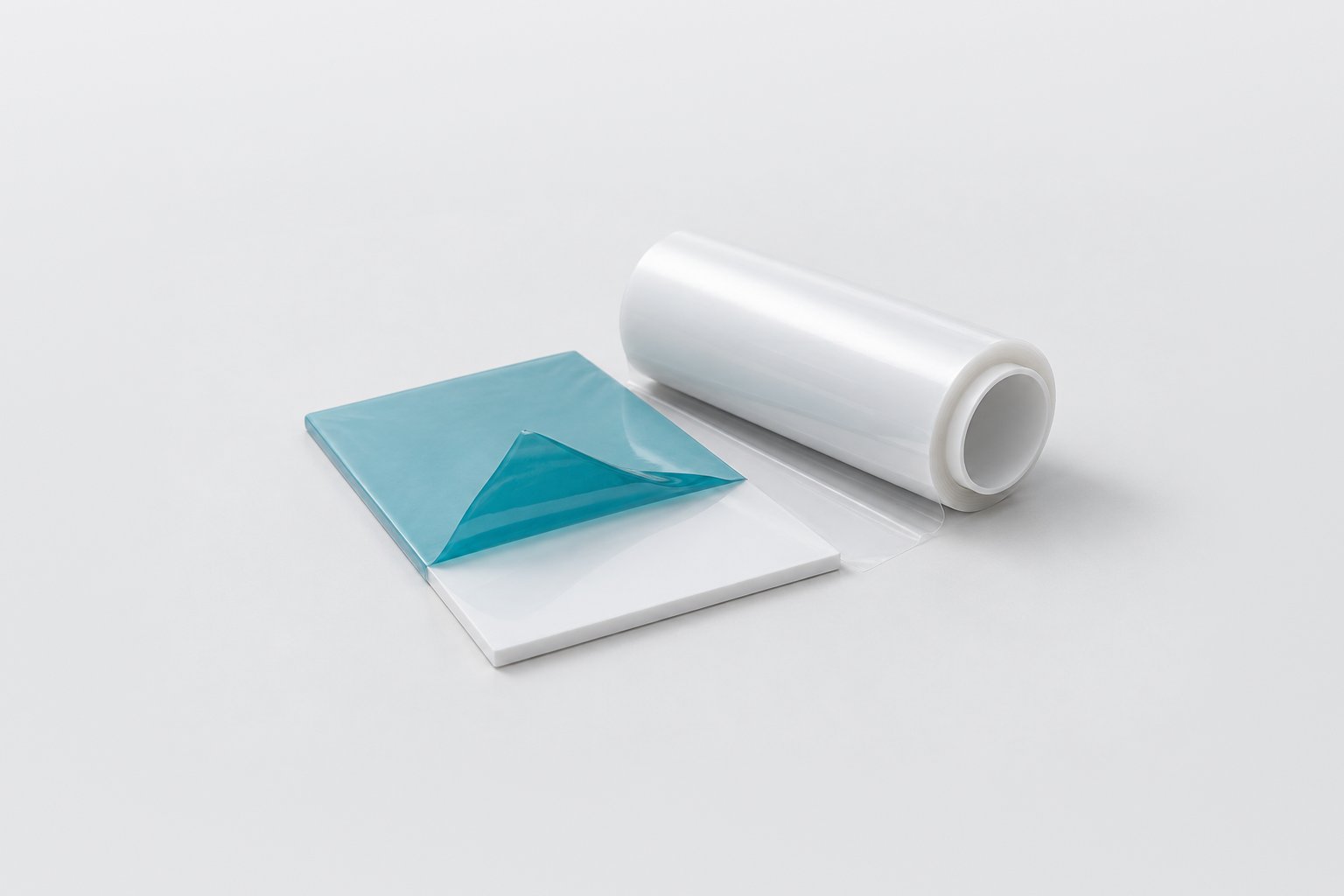
A surface protection film grade has to leave the surface exactly as it found it. Film on a window profile, a steel sheet or a gloss panel is peeled off at the end of the job, and any mark it leaves becomes the converter's complaint. This page covers film that is not a food pack: protective, release, hygiene, stationery and textile film, and the grades we can supply for them.
— REQUIREMENTS
What technical film has to do
Protective film must stick evenly and stay on through forming or transport. Then it must come off cleanly. A gel in the film presses into a soft or polished surface and leaves a dent. Release film must part from an adhesive or a composite without tearing. Hygiene backsheet needs softness and an even gauge, and stationery film needs a flat, print-ready surface.
Much of this film is thin, so a small defect shows. On the converting line every roll has to unwind without blocking and slit with straight edges.
— SELECTION
Choosing a low gel LDPE film grade
Low-gel LDPE without additives is the usual start for protective film. Slip agents migrate to the surface, so film that carries an adhesive coat or touches a sensitive surface normally runs without slip or antiblock.
HDPE gives stiff, thin film that lies flat, for release liners, labels and synthetic paper.
PP random copolymer cast film is clear and soft, for stationery folders, sleeves and textile packs. PP homopolymer cast film is stiffer and glossier.
Easy-flowing LDPE suits hygiene film and extrusion coating, where a thin, even layer matters more than toughness. Hygiene film is often laminated to a nonwoven web, covered on nonwovens.
Compare gel level first. If a data sheet describes gels only in words, ask for film from a trial before you commit a critical surface to it.
— GRADES
Grades we can supply
Check each data sheet for additives and gel level before trials on a sensitive surface.
PP homopolymer
KeyForm
·
Velogy
PP
KeyForm P1003
PP homopolymer
KeyForm P1003 is a high-flow polypropylene homopolymer for biaxially oriented polypropylene (BOPP) film on tubular double-bubble lines and for cast film.
Film extrusion
BOPP
Industries

Flexible packaging
KeyForm
·
Velogy
PP
KeyForm P1002
PP homopolymer
KeyForm P1002 is a polypropylene homopolymer without slip or antiblocking additives, for cast film. Typical uses include packaging and lamination films for food, flowers, books, stationery and textiles.
Film extrusion
Industries
Flexible packaging
KeyForm
·
Velogy
PP
KeyForm P1050
PP homopolymer
KeyForm P1050 is a polypropylene homopolymer containing slip and antiblocking additives, for cast film. Typical applications include packaging and lamination films for food, flowers, books and stationery.
Film extrusion
Industries
Flexible packaging
PP random copolymer
AdvyForm
·
Velogy
PP
AdvyForm R1001
PP random copolymer
AdvyForm R1001 is a controlled-rheology, medium-modified propylene random copolymer for transparent cast film. It contains no slip or antiblocking agents.
Film extrusion
Industries
Flexible packaging
AdvyForm
·
Velogy
PP
AdvyForm R1050
PP random copolymer
AdvyForm R1050 is a controlled-rheology, medium-modified propylene random copolymer for transparent cast film. It contains slip and antiblocking additives.
Film extrusion
Industries
Flexible packaging
AdvyForm
·
Velogy
PP
AdvyForm R1051
PP random copolymer
AdvyForm R1051 is a controlled-rheology, medium-modified polypropylene random copolymer for cast film. It contains slip and antiblocking additives.
Film extrusion
Industries
Flexible packaging
LDPE
KeyForm
·
Velogy
LDPE
KeyForm L0400
LDPE
Non-additivated low-density polyethylene with high melt strength for blown-film extrusion and good bubble stability.
Blown film extrusion
Film extrusion
Industries
Flexible packaging
KeyForm
·
Velogy
LDPE
KeyForm L0600
LDPE
KeyForm L0600 is a non-additivated low-density polyethylene, supplied as pellets. Its good melt strength supports bubble stability during blown-film extrusion.
Film extrusion
Blown film extrusion
Industries
Flexible packaging
KeyForm
·
Velogy
LDPE
KeyForm L0850
LDPE
KeyForm L0850 is a low-density polyethylene containing slip and antiblocking additives. It offers a balance of processability and mechanical properties.
Film extrusion
Blown film extrusion
Industries
Flexible packaging
— NEED HELP CHOOSING?
Not sure which grade fits?
Tell us the surface or product the film protects, the gauge and how the film is converted.
— PROCESSING
Gauge and gel control on the line
Gels come from the resin and from the line: degraded melt in dead spots, or a worn screen pack. Clean filtration and a steady melt temperature keep a low-gel grade low in gels. Cast film gives tighter gauge and better clarity; blown film is tougher and more balanced. Tell us the line, die and screen pack.
Blown film extrusion
Film extrusion
— DOCUMENTATION
Documents for non-food film
Most technical film never touches food, so the documents that matter are the safety data sheet under the REACH Regulation (EC) No 1907/2006 and the producer's regulatory summary. The safety data sheet also lists uses the producer advises against, which can include some medical uses. Hygiene film touches skin, so ask for the regulatory summary of the exact grade. Textile and stationery packs are packaging under Regulation (EU) 2025/40, like any other pack.
— PRODUCERS
Producers for this application

Brands for this application
— FAQ
Common questions
What makes a good release film polyethylene?
Which hygiene film grade suits a backsheet?
Why does my protective film leave marks?
— RELATED


