— APPLICATION
PP fibre grades for staple fibre, filament and BCF yarn
A PP fibre grade is judged after the draw. Staple fibre, continuous filament and bulked carpet yarn are all stretched after spinning, and that step sets their tenacity, denier and look. Polypropylene is light and takes up almost no water, so it is common in carpets, upholstery, ropes and geotextiles. This page explains how melt flow, molecular-weight distribution and stabilisation steer the choice of grade, and shows the grades we can supply.

— REQUIREMENTS
What the yarn has to do
High-tenacity yarn for ropes, webbing and geotextiles needs strength at a given denier, and filaments that do not break on the godets. Fine-denier staple for nonwovens and textiles needs an even cross-section, because thick and thin spots become weak points and show as lustre differences. Carpet yarn has to bulk evenly and keep its colour under foot traffic. White and pale fibre also has to survive the warehouse. Exhaust from forklifts and heaters carries nitrogen oxides, and those turn unprotected fibre yellow.
— SELECTION
Staple fibre, continuous filament and BCF polypropylene yarn
Melt flow sets the route. Lower-flow homopolymers give the strength for high-tenacity staple and technical yarn. Higher flow suits fine-denier staple, partially oriented yarn (POY) and fast continuous-filament spinning, where the melt has to draw down thin without breaking.
A narrow molecular-weight distribution, usually reached by controlled rheology, keeps spinning stable at high speed and fine denier. Random copolymer filament is softer and more flexible than homopolymer, and usually a little less strong.
Some grades are documented for both bulked continuous filament (BCF) and fine staple. If you switch between the two, check that the data sheet names both routes.
For white or pastel fibre, look for an anti-gas-fading stabiliser package. Polypropylene fibre is coloured in the melt, with masterbatch added at the spinning line. Its carrier should suit the grade's flow (see compounding and masterbatch).
HDPE also spins into tape and monofilament for ropes and geotextiles; netting has its own page, nets and monofilament. Spunbond and meltblown webs are covered on nonwovens.
— GRADES
Grades we can supply
Check that the data sheet names your route before a line trial.
PP homopolymer
KeyForm
·
Velogy
PP
KeyForm P0711
PP homopolymer
KeyForm P0711 is a polypropylene homopolymer for extrusion of high-tenacity staple fibres. It contains an anti-gas-fading stabilisation package.
Fibre and nonwoven
Industries
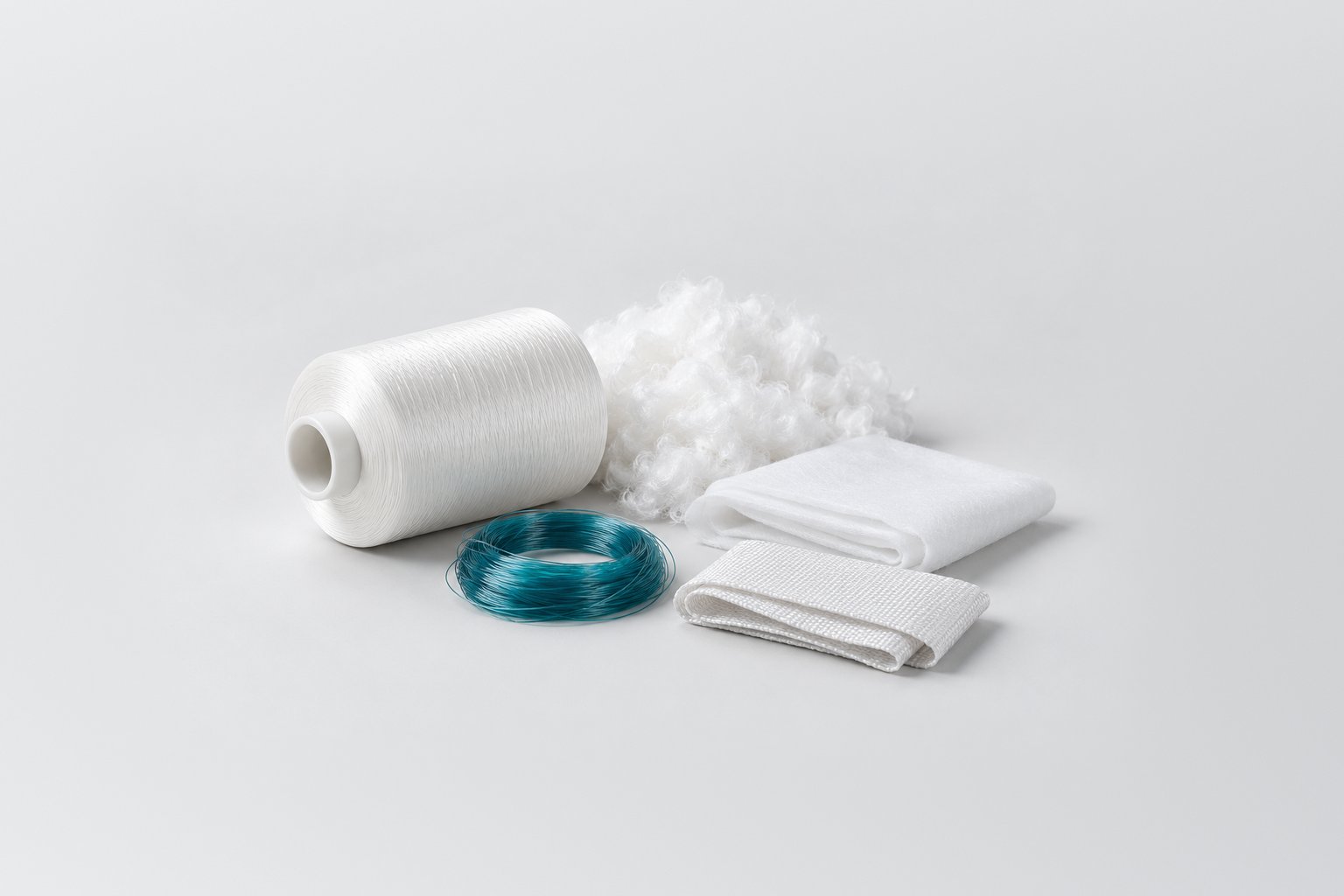
Fibres & nonwovens
KeyForm
·
Velogy
PP
KeyForm P0810
PP homopolymer
KeyForm P0810 is a polypropylene homopolymer for extrusion of high-tenacity staple fibres. It contains an anti-gas-fading stabilisation package.
Fibre and nonwoven
Industries
Fibres & nonwovens
KeyForm
·
Velogy
PP
KeyForm P0910
PP homopolymer
KeyForm P0910 is a polypropylene homopolymer for extrusion of staple fibres. It contains an anti-gas-fading stabilisation package.
Fibre and nonwoven
Industries
Fibres & nonwovens
HDPE
KeyForm
·
Velogy
HDPE
KeyForm H0500
HDPE
KeyForm H0500 is a high-density polyethylene with medium molar mass and a narrow molar-mass distribution, for tapes.
Film extrusion
Blown film extrusion
Industries

Industrial
Fibres & nonwovens
KeyForm
·
Velogy
HDPE
KeyForm H0501
HDPE
KeyForm H0501 is a high-density polyethylene with medium molar mass and a narrow molar-mass distribution, for tapes. It offers very good bubble stability and processability.
Film extrusion
Blown film extrusion
Industries
Industrial
Fibres & nonwovens
KeyForm
·
Velogy
HDPE
KeyForm H0620
HDPE
KeyForm H0620 is a high-density polyethylene with medium molar mass and a narrow molar-mass distribution, for monofilaments. It contains a lubricant and is described as easy-flowing, with good processing performance on monofilament lines.
Film extrusion
Fibre and nonwoven
Blown film extrusion
Industries
Fibres & nonwovens
— NEED HELP CHOOSING?
Not sure which grade fits?
Tell us your fibre route, target denier, line type, current grade and the end product.
— PROCESSING
Spinning and drawing
Staple, filament and BCF lines each run in a narrow window of melt temperature, quench air and draw ratio. Tell us your line type, target denier and current grade. We match on melt flow first, then on molecular-weight distribution and stabilisation, and can arrange samples for a line trial. The polypropylene overview explains how homopolymers and random copolymers differ.
Fibre and nonwoven
Extrusion
— DOCUMENTATION
Labelling and documentation
Textile products sold in the EU must be labelled with their fibre composition. The label may only use the fibre names in Annex I of Regulation (EU) No 1007/2011, and "polypropylene" is one of them. The manufacturer of the finished product supplies the label. Geotextiles for roads are CE marked by their maker against EN 13249. For each grade we pass on the producer's safety data sheet and regulatory summary.
— PRODUCERS
Producers for this application

Brands for this application
— FAQ
Common questions
Which melt flow do I need for staple fibre?
Why does white PP fibre turn yellow in storage?
Which PP suits geotextiles?
— RELATED


